The marketing sector involves informing consumers that your product and service is above the standard of other businesses. Within Media, this definition still stands true compared to that within the Business industry. It ties in very well with advertising, although they are not to be confused as the same practice, they are merely correlated sectors.
There are four P's of marketing;
- Product: What is being sold?
- Promotion: Why should one buy it?
- Price: How much will the product cost?
- Place: Where will you be able to buy it?
Viral marketing is a very powerful tool used to raise awareness and gain popularity for something new.
Sit back whilst I explore the different ways in which the hotly anticipated The Dark Knight Batman film was marketing to the public in innovative, interactive and exciting new ways.
In May 2007, a very well orchestrated viral marketing campaign was formed surrounding the release of the second Christopher Nolan Batman film.
Various websites were set up such as;
- whysoserious.com - The Joker
- ibelieveinharveydent.com - Harvey Dent
whysoserious.com
 Why So Serious featured a 'To Do' list for the fans to partake in a scavenger hunt that led to uncover clues in different locations as well as receiving the first image of the Joker with trailers and audio clips The completion of the scavenger hunt led to another website called Rory's Death Kiss where fans were able to submit photographs of themselves costumes the Joker. Those who submitted images were mailed a copy of a fictional newspaper The Gotham Times. The electronic version of the paper led to the discovery of numerous other websites.
(This website is still able to view.)

The first image released of the Joker.
ibelieveinharveydent.com
This is Harvey Dent's political campaign website. 'I Believe In Harvey Dent'.
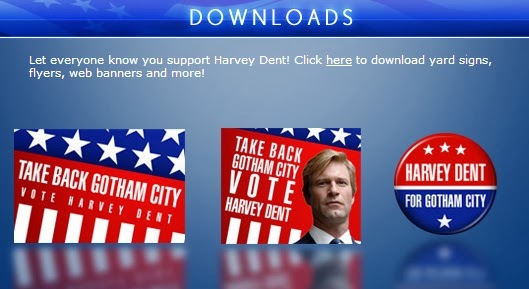 Harvey Dent Support Downloads (still available for those still living the Harvey Dent Gotham City dream)
They were created as promotional propaganda for Harvey's campaign
 Dent's Supporters take to the streets.
The website aimed to interest fans by having them earn what they wanted to see. On behalf of Warner Bros., 42 Entertainment also formed a 'vandalised' version of I Believe in Harvey Dent called I Believe in Harvey Dent Too. E-mails sent by fans slowly removed pixels and the first official image of the Joker was revealed. Not long after, the content on I Believe in Harvey Dent Too was erased and replaced with 'HaHa' all over the page and a hidden message saying 'See you in December'.
As well as a successful viral marketing campaign, theme parks Six Flags Great America and Six Flags Great Adventure opened the Dark Knight roller coaster, costing $7.5 million to develop. The theme of the rollercoaster was to give the impression that the active audience were being stalked by the Joker.
Mattel also produced toys and games for the film as well as action figures, costumes, board games, puzzles and a special-edition of the card game UNO.
Note; all of the marketing tools were released ahead of the films release, this is to bring as much attention to the film ready for its worldwide release.
There are four P's of marketing;
- Product: What is being sold?
- Promotion: Why should one buy it?
- Price: How much will the product cost?
- Place: Where will you be able to buy it?
Viral marketing is a very powerful tool used to raise awareness and gain popularity for something new.
Sit back whilst I explore the different ways in which the hotly anticipated The Dark Knight Batman film was marketing to the public in innovative, interactive and exciting new ways.
In May 2007, a very well orchestrated viral marketing campaign was formed surrounding the release of the second Christopher Nolan Batman film.
Various websites were set up such as;
- whysoserious.com - The Joker
- ibelieveinharveydent.com - Harvey Dent
whysoserious.com
(This website is still able to view.)
The first image released of the Joker.
ibelieveinharveydent.com
This is Harvey Dent's political campaign website. 'I Believe In Harvey Dent'.
They were created as promotional propaganda for Harvey's campaign
The website aimed to interest fans by having them earn what they wanted to see. On behalf of Warner Bros., 42 Entertainment also formed a 'vandalised' version of I Believe in Harvey Dent called I Believe in Harvey Dent Too. E-mails sent by fans slowly removed pixels and the first official image of the Joker was revealed. Not long after, the content on I Believe in Harvey Dent Too was erased and replaced with 'HaHa' all over the page and a hidden message saying 'See you in December'.
As well as a successful viral marketing campaign, theme parks Six Flags Great America and Six Flags Great Adventure opened the Dark Knight roller coaster, costing $7.5 million to develop. The theme of the rollercoaster was to give the impression that the active audience were being stalked by the Joker.
Mattel also produced toys and games for the film as well as action figures, costumes, board games, puzzles and a special-edition of the card game UNO.
Note; all of the marketing tools were released ahead of the films release, this is to bring as much attention to the film ready for its worldwide release.
What are your thoughts on Warner Bros/42 Entertainment's marketing strategies for TDK? Were you lucky enough to be a part of the madness and hunts?